
Are You Ready for Virtual Power Plants? And Just What Are They?
With the exponential rise of home solar installations, plenty of UK households now have (or are also adding) battery storage. And let’s not forget about all those giant batteries in EVs that sit about mostly at home. So, the obvious follow-up question is: can that battery do more than just back up your house or soak up free solar?
And can it actually earn its keep by helping the wider energy system? Can it even repay you for its purchase costs quickly?
The answer is yes, and it’s called a Virtual Power Plant, or VPP. It’s one of those behind-the-scenes technologies that sounds technical but is about to become very normal for anyone with a battery, solar, or soon (we hope) an electric car.
What Exactly Is a VPP?
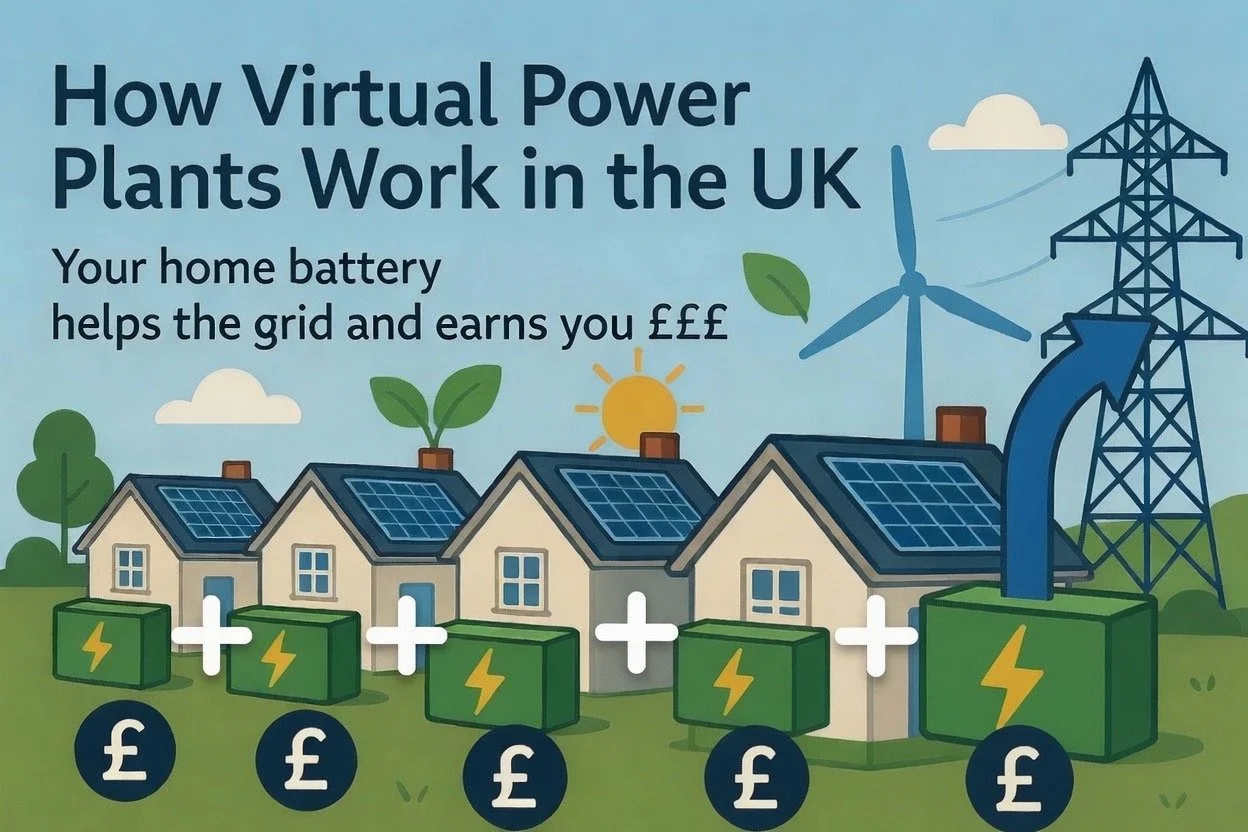
Think of it as lots of small, distributed energy devices (home batteries, solar panels, smart EV chargers, even heat pumps) all linked up and coordinated by clever software. On their own, like my 18kWh home storage and 77kWh car (which is a lot for one home) they’re tiny in the grand scheme of things when it comes to the scale of UK required Grid energy.
But, aggregated together they act like one big, (potentially very big) flexible power station. A ‘virtual’ one.
When the grid needs extra power or wants to shift demand around, the VPP can tell thousands of home batteries to discharge a little, or EVs to pause charging (or even push power back out). It’s automated, respects your settings/won’t completely flatten your battery and happens in short to longer periods.
You don’t have to do anything day-to-day, it just runs in the background via your energy supplier or a specialist platform.
Why Do We Need This?
Well, demand flexibility is the hot topic and the UK grid is changing fast. Renewables - especially wind and non-domestic solar - now supply a huge and growing chunk of our electricity, but they don’t generate on demand, the wind doesn’t always blow when we all put the kettle on at 6pm and as the “angries” on social media like to shout “solar doesn’t work at night”. Well it does when you add in storage, but that’s another article for another time.
Things are changing and growing fast! And we’re electrifying everything: more heat pumps, more EVs, more data centres and with industry shifting to electric. That creates bigger peaks in demand and more variability demands.
Traditional fixes are expensive: building lots of new gas ‘peaker’ plants, massive grid upgrades, or over-building generation capacity that sits idle most of the time, take time and money to build out.
These grid upgrades, whilst they are happening, and needed, are time consuming and also expensive.
VPPs offer a smarter, cheaper, cleaner alternative. They turn millions of existing (and future) home devices into flexible resources that help balance supply and demand in real time. They can be asked to supply electricity to the grid in peak times as well as being instructed to soak up electricity in times of excess. This balances the grid and keeps bills lower for everyone, reduces the need for fossil fuel backups, and lets us add even more renewables without the system falling over.
It’s decentralised, resilient, and scales quickly, exactly what a modern grid needs. Even better, let a VPP use your system and you will be rewarded for it, and sometimes handsomely, too.
What’s Available Right Now?
There are two main routes most people will encounter:
Octopus Energy (Flux + Kraken platform)
Octopus already orchestrates one of the largest residential VPPs in the world. With a compatible battery, including their new plug-and-play options, their Intelligent Octopus Flux tariff optimises charging and discharging. It charges when power is cheap and green, then exports or shifts use during peaks. Many users see meaningful bill savings plus decent export rates. It’s all handled in the app very much user hands off.
Axle Energy
An independent VPP platform that works with a growing list of batteries (Fox ESS, GivEnergy, Sigenergy, SolaX etc.). Customers stay with their supplier and it just accesses the system as required.
During short grid stress events your battery exports power and you get paid-typically £1 per kWh, plus a guaranteed minimum (around £10/month). Simple, transparent, and works alongside self-consumption.
I’ve been on the Axle scheme a few months now and it has been great. There’s also a £25 sign up bonus if you use someone’s referral. **
Both are live and growing and real earnings vary with battery size and location, but they are a useful extra way of getting the customers system to reward them further, and pay back with very little hassle.
The Big Exciting Future: Your EV Joining In (V2G)
Here’s where it gets really exciting, and why VPPs will be a much bigger deal in the coming years.
Right now it’s mostly home batteries doing the heavy lifting. But Vehicle-to-Grid (V2G) technology lets your EV’s battery do exactly the same job when it’s plugged in. Electric cars carry a massive battery pack that can export power back to the grid (or directly into owners homes) during peaks, and recharge when it’s cheap.
For now it’s still niche requiring quite expensive equipment in the shape of a compliant V2G EVSE wall charger.
Why is this a massive deal?
• The average EV is parked 95% of the time. That’s an enormous pool of under-used energy storage sitting on driveways and workplaces across the country.
• Millions of EVs in the future = gigawatts of flexible capacity without needing to manufacture and install millions of extra home batteries.
• It can make EV ownership even cheaper and some trials and early tariffs offer free or heavily subsidised charging in exchange for letting the car assist the grid at the right times.
• It accelerates the whole energy transition: more renewables means fewer gas peaker plants used, with lower system costs, and greater energy security.
We’re already seeing the first commercial steps in the UK and Europe. Octopus has run Powerloop V2G trials and launched early mass-market style tariffs. And companies like Axle are working directly with car makers and charger manufacturers on consumer propositions that are expected to hit the market in 2026 and beyond. Nissan/Renault, BYD and others are involved, and bidirectional chargers and compatible electric cars are becoming readily available now.
In a few years time, when you plug in your EV at home, it won’t just charge, it could quietly earn you money or cut your bills further while helping keep the lights on for everyone. That’s a game-changer for both drivers and the grid.
If you’re getting solar and a home battery now or soon, it makes sense to factor in VPP participation from day one. And if you’re thinking about an EV in the next few years, keep an eye on V2G-ready models as well as compliant home energy tariffs, because the financial upside could be significant.
The technology is maturing fast so watch this space!
If anyone already on Flux, Axle, or a V2G trial, we would love to hear your real-world numbers or experiences over on socials: @ctrlaltrefuel
** Send a message to @eV_Newt on X for an Axle referral code
