Cars Have Become XXL Creating Parking Problems
There really is no way to sugar coat this other than calling out car fatness, because over the years familiar brands and their models have put on some weight with increased proportions.
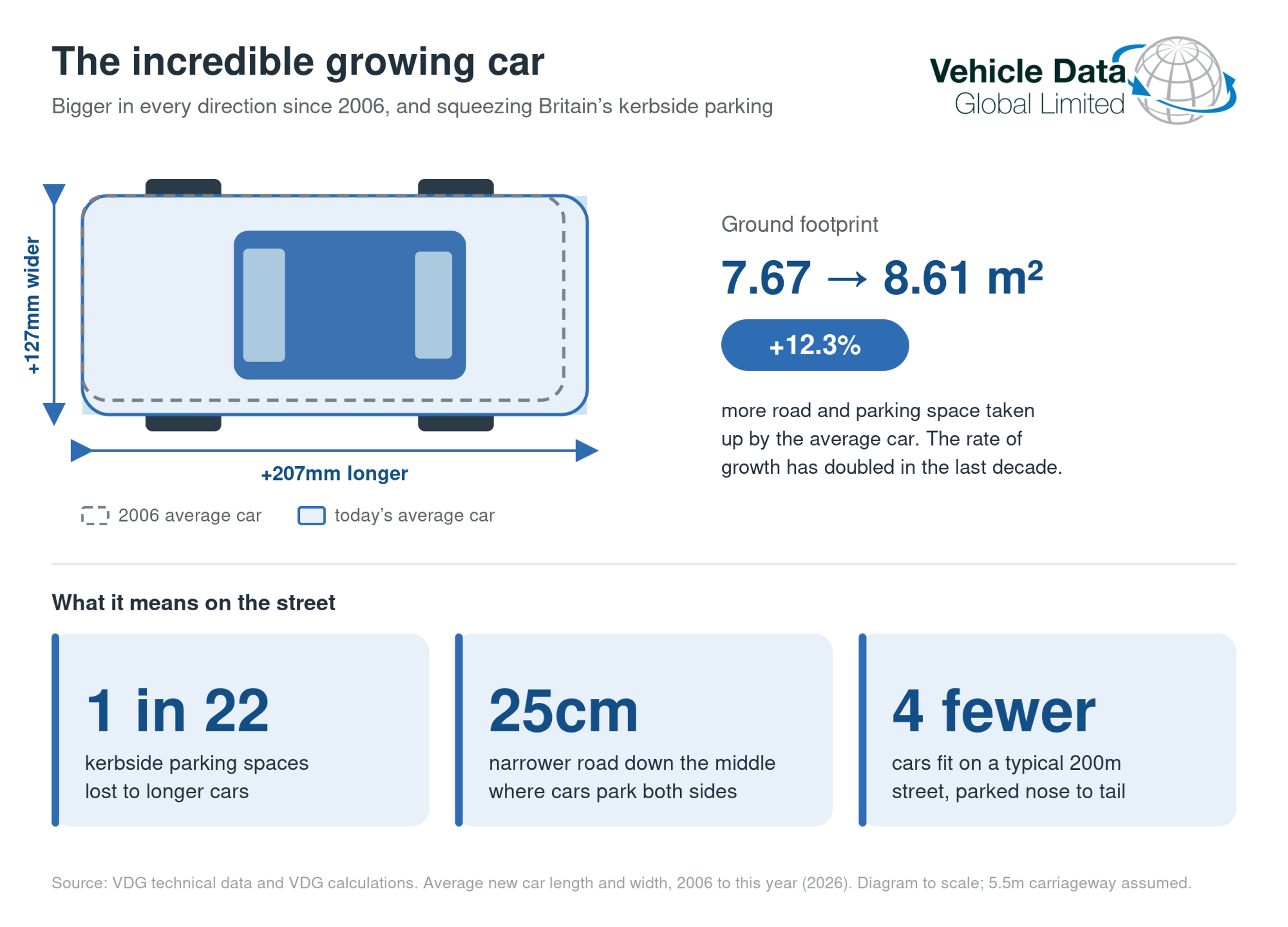
According to research by Vehicle Data Global, car dimensions have grown significantly over the last 20 years creating a parking crisis for many motorists, with the average car now occupying over 1 meter squared more space. This translates to less parking spaces available for residents with on-street parking only, and that means cars spill into other neighbourhoods, congesting more roads.
VDG analysis claims that the average car is now 8.61 meters squared in 2026 vs 7.67 meters squared in 2006.
But it’s not down to the adoption of SUV’s that’s to blame - although 59.5 % of vehicles sold in the U.K. are SUV’s according to SMMT data - because most cars have grown significantly in size. Take for example the Ford Focus that has grown from 7.07 meters squared of footprint to 8.02 meters squared at its last iteration, representing a +13.4 % growth spurt.
The Vauxhall Corsa has also grown by over a meter squared, and is now 19.3 % larger than it’s 20 year old sibling, whilst the Volkswagen Golf has grown 12.4 % in just two decades.
Around 32% of households in England have on-street parking only causing significant parking issues in residential areas.
An increase on average by a meter squared may not sound much, but compound that over an entire street, and the pinch point arrives. For example, for a 200 meter long street, there are four fewer parking spaces available.
However, for streets with parking on both sides, the gap between the cars - or drivable area - has been significantly reduced, compounded by cars driving through that have become much wider over time.
For a typical 5.5 metre wide residential street, the drivable lane has narrowed from about 1.89 metres in 2006 to 1.64 metres - thanks to girthier cars - which is similar to having width restrictions throughout the entire road. This impedes service vehicles and emergency service vehicles navigating through the narrow drivable lanes with cars parked either side.
It’s not just an inconvenience, because invariably more cars will become damaged as the driveable passage becomes narrower. This increases insurance claims with costs passed on to motorists.
VDG says “In 2006 the street could accommodate 94 cars, parked nose to tail - but that number has shrunk to 90. Allowing a more realistic half-metre between vehicles to pull in and out, the street could take around 84 cars in 2006, but only about 81 today, leaving three or four without a space”. They mention “The rate of size increase doubled in the past 10 years alone, resulting in the average car this year occupying 0.64 square metres more space than in 2016 and 0.94 metres more since 2006”.
Another issue is that whilst cars have grown significantly over the last 20 years, car parking spaces, and car parking provisions have not. With so many households feeling the strain and stress of finding parking, the RAC estimates that, since 2012, seven millions homes now have added parking areas in lieu of front gardens.
Ben Hermer, Operations Director of VDG, said: "While the sheer volume of cars on the road, compared with a few decades ago, tends to dominate media stories about parking problems, our analysis shows the inevitability of even greater parking pain due to the steady increase in vehicle dimensions.
"With the average car taking up more space than ever before, many drivers without off-street parking are increasingly squeezed out of the spaces they would have had 20 years ago.
"It shows that the increase in interior space and comfort that we all enjoy in modern cars has come at a significant cost in stress for millions of drivers."
CtrlAltRefuel colleague eV Newt has a fondness for small, affordable cars and EVs with his automotive menagerie of zippy, little runabouts. But, this is the exact attitude that needs to be fostered, and it brings about the question we should ask ourselves; “do we need so many large cars?”
Author
Graeme Cobb is a car enthusiast who loves writing about cars, EVs and the automotive industry. 100% Amateur.
You can find Graeme on 𝕏 at @graeme_cobb