
Pragmatism Over Pride: Ford and Geely Team Up (in Spain)
Ford and China’s Geely recently announced that they have inked a new joint venture for Ford’s giant Valencia plant in Spain. The deal is a pragmatic one: Ford owns 66%, and Geely takes 34%. The JV is due to start operating in the first half of 2027, with new cars rolling off the line from 2028.
To understand why Ford is opening its doors to a major Chinese competitor, you have to look at CEO Jim Farley’s playbook:
A while back, I watched Robert Llewellyn interview the Ford CEO on the Fully Charged (sorry, Everything Electric as it’s now known) podcast and Farley comes across as a proper, old-school car guy - dynamic, hands-on, Blue Collar even, and not your typical corporate head accountant.
During the interview, he talked about how Ford had ended up with overly complex products, built from disparate control modules, made by other companies, that didn’t talk to each other properly and certainly not in the same ‘language’.
When Ford engineers finally stripped down a Tesla, they were shocked at how much simpler and more integrated it was. Farley later admitted publicly that the Mustang Mach-E, for example, had roughly a mile more wiring than a Model 3, meaning the Ford carried extra weight, complexity, and cost that Tesla had simply designed out.
Tesla essentially has one computer controlling pretty much everything, whereas traditional auto makers rely on modules that are plugged, with the car running multiple ECU’s. Tesla’s software-first approach was a wake-up call to the industry because, to get to this level of integration, software is hard. Very hard, in fact. And this is unfamiliar territory for the industry.
Farley’s admiration doesn’t stop at the house of Tesla though. Far from it. He is also a very vocal fan of Chinese manufacturing and their EVs. On that same podcast, he disclosed that Ford had imported a Xiaomi SU7 from Shanghai so he could drive it in the US. He called it "fantastic" and admitted he didn't want to give it up.
So when you see Ford tying up with Volkswagen, Renault, and now Geely for platforms and manufacturing, it’s both a surprise and paradoxically also not a surprise.
Farley knows exactly how far behind the old way of doing things has left legacy automakers, and for the sake of survival, needs must.
The Valencia Problem
The plant in Valencia has been underused for a while. It has the capacity to produce around 500,000 vehicles a year, but it has been running well below that, mainly churning out the ageing Kuga. Sharing the factory makes immediate sense for both sides.
So who are Geely? Well, they’re one of China’s largest automotive groups. Ironically, Geely bought Volvo from Ford back in 2010, and their umbrella now includes Polestar, Lotus, Zeekr, Smart and major domestic volume brands under their own name. They have solid EV technology and the capital to expand globally. This Spanish deal gives them their first major European production footprint without the headache of building a plant from scratch.
What They’re Going to Build
Ford will keep the Kuga going while adding two new multi-energy models: an all-new crossover designed by Ford and developed with Geely, and a new compact, rugged SUV for the Bronco family.
"Multi-energy"by the way, means a mix of pure electric, plug-in hybrid, and range-extender powertrains so Ford can pivot to whatever European buyers demand.
Multi-fuel platforms haven't always produced great results (look at Stellantis's mixed bag) so it remains to be seen whether "Forly" (Geord?) can deliver something better.
In return (and this is the clever move for me), Geely gets to build two of its own electric SUVs in Valencia, with the EX5 (known as the Galaxy E5 in China) expected to be the first. And this means there are no import tariffs accrues to Geely cars sold in Europe, being locally made.
Existing Valencia workers will transfer across to the new JV and Geely has stated it won't be shipping in workforce from China, so higher factory volumes should help protect local employment.
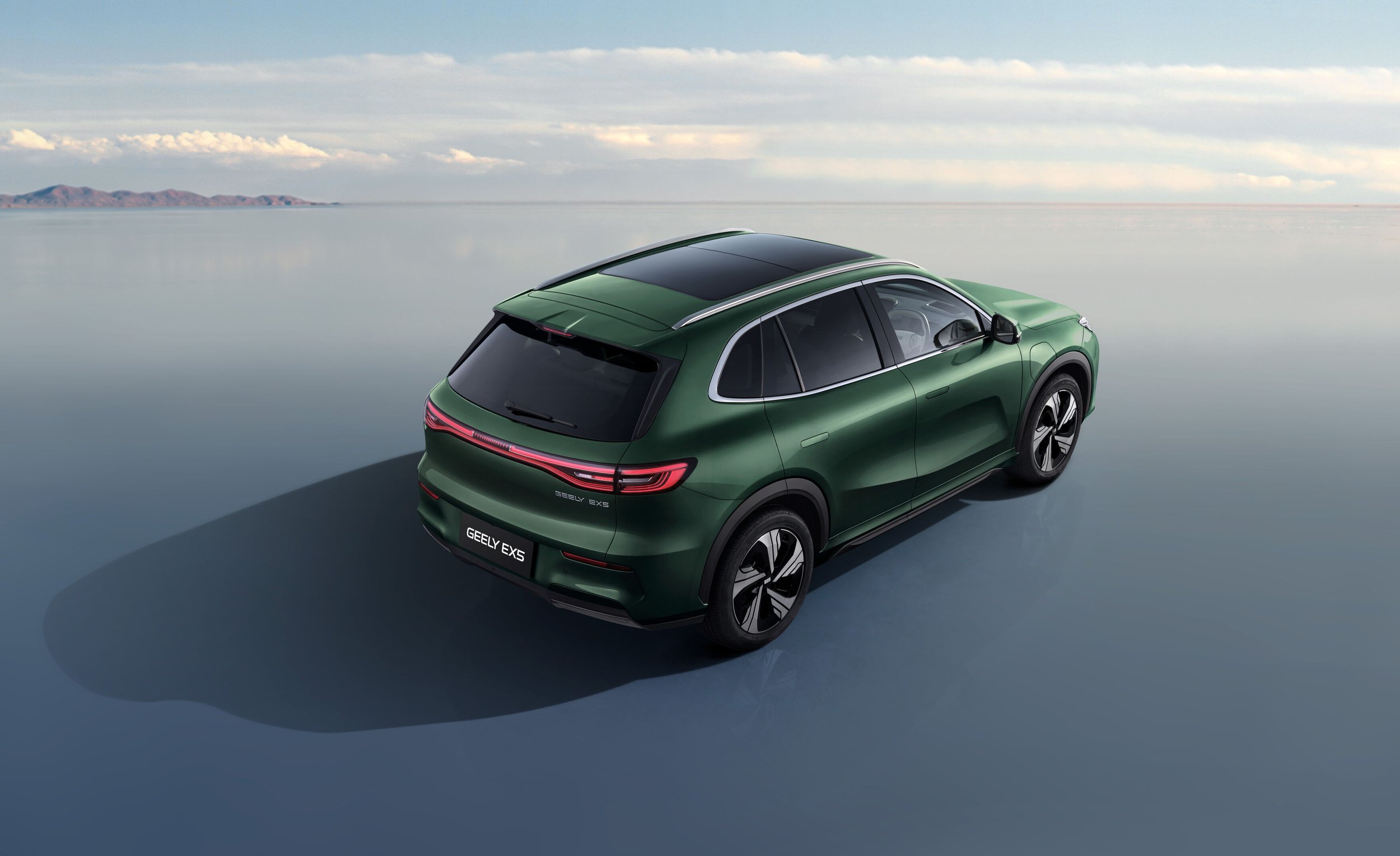
Geely EX5
Why Ford Made the Move
Europe is expensive and fiercely competitive, and Ford’s passenger car market share has been shrinking for years, so developing everything from scratch costs a fortune. Partnering allows them to share development costs, de-risk platforms, and keep the Valencia workforce employed without writing a massive cheque for a new architecture.
It’s the same logic driving their other recent moves. The new Explorer and (questionably named) ‘Capri’ EVs sit on Volkswagen’s MEB platform.
The upcoming electric Fiesta (due 2028) will use Renault/Nissan’s AmpR R5/Micra Small platform and will be built in France, and now Geely enters the frame for bigger, multi-energy vehicles built in Spain.
You could call it flip-flopping. VW one minute, Renault the next, and now Geely. But when European volumes decline and Chinese brands are taking market share, taking partners keeps Ford in the game, even if it loses some Fordyness.
An Industry-Wide Shift
Ford isn't the only ones doing this. Nissan has struck a similar deal in Sunderland, signing with Chinese automaker Chery to build vehicles on its lines from 2027 to fill spare capacity and bypass tariffs. Meanwhile, the Stellantis-Leapmotor joint European venture is already producing very good ground-up architecture for their EVs.
The old model of every legacy automaker designing and building everything in-house is fading fast. Shared factories and multi-brand platforms are becoming the new baseline. The risk, of course, is brand dilution. If platforms are shared across competitors, the ‘Ford DNA’ across the models will be missing, perhaps. Will a Ford still ‘feel like a Ford’ across the models? Most likely no-in my opinion.
We’ll find out soon when the first models roll off the Valencia line in 2028. Until then, the Kuga keeps rolling on.
Will legacy names eventually be swallowed by new-age Chinese groups, or will traditional brands survive purely as badging operations? What do you think?
