Fuel Efficiency Has Declined Over a Decade Despite Adding Fuel Saving Tech
A report by data technology specialists, Vehicle Data Global Ltd, has concluded that there has been a significant decline in fuel efficiency compared to a decade ago, and this is despite the EU regulating for cleaner emissions and better fuel economy. So, what has gone wrong and why?
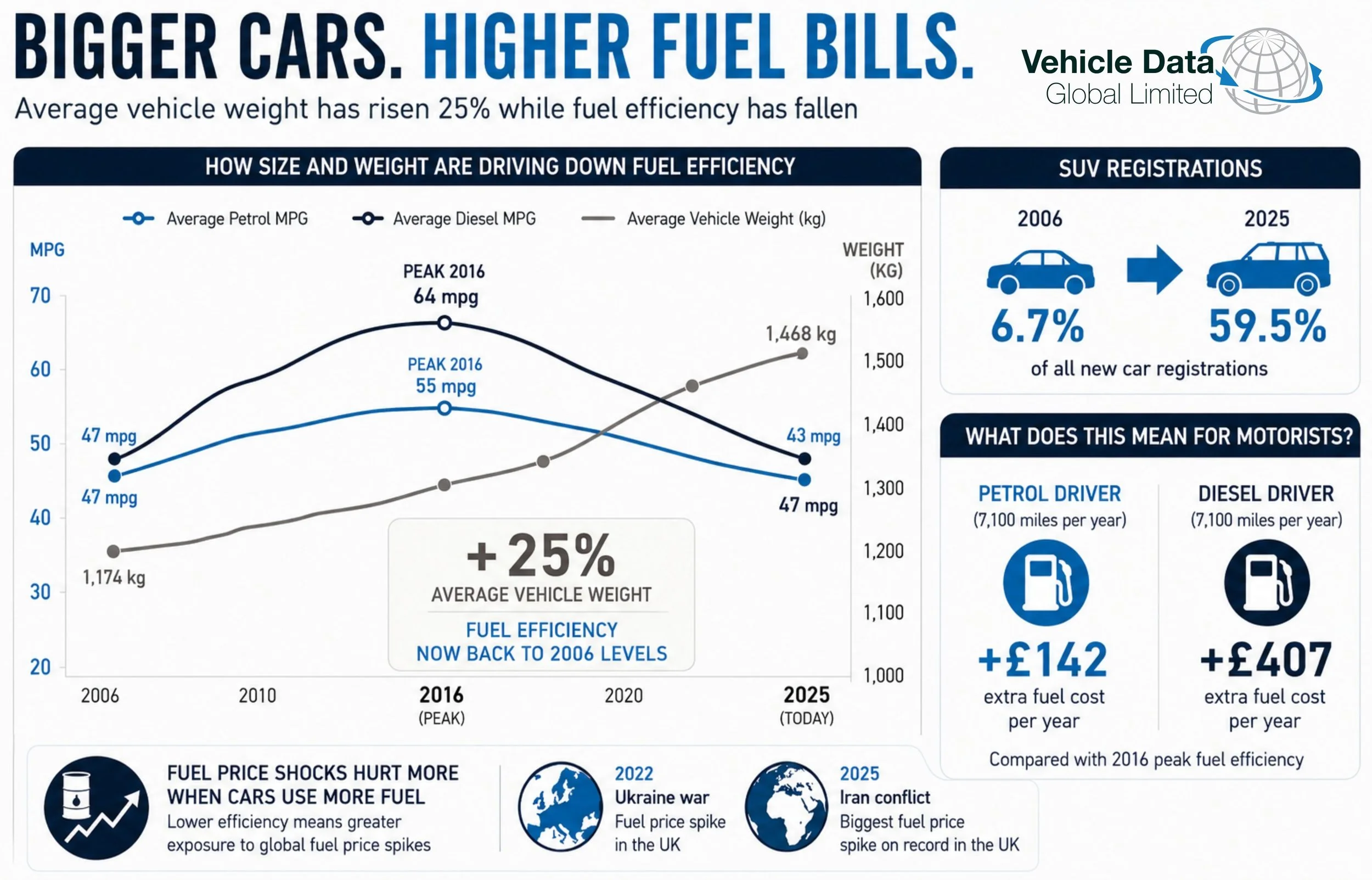
The VDG report highlights the average petrol car fuel efficiency peaked at 55 mpg in 2016, then fell back to 47 mpg in 2026, with the root cause being trends in consumers buying bigger and heavier cars.
To highlight this point, the average petrol MPG is now approximately where it was 20 years ago despite huge advances in technology to make engines burn less fuel. The likely culprit is the SUV - which by all accounts - not only comprises of 60% of the market share now, but offers very few advantages over a much more economical hatchback.
For diesel it’s worse because average economy figures stood in 2016 at 64 mpg, but is now just over 43 mpg, worse than in 2006 when it was at 47 mpg. However, it was the dieselgate scandal that broke ‘that’ camel’s back, because back then almost all makes and models offered a diesel option, even the B segment cars, and some A segment one’s, too. With diesel cars receiving very bad press, and customers cars being directly impacted, sales declined.
Diesel cars attributed to nearly half the cars on sale in 2016. Today that market share has dropped to just over 4%, with large SUV’s such as the new Audi Q7 (cover picture) arriving with a diesel engine only. The concentration of diesel’s sold in large SUV’s from a very small market share will undoubtedly sway the average results.
But, the biggest highlighter of this anomaly has come from the war in Ukraine and - more recently - the war in Iran affecting supplies and driving up costs at the pumps. And this double whammy of uneconomical cars and high pump prices is costing Britons dearly.
To provide a hard hitting truth, diesel prices have increased 70% over 10 years. It sounds outlandish, but it’s a slow burn upwards to the point where it’s becoming very uncomfortable with each fill up. 60 litres of diesel can cost over £110 now, a rise from around £65 ten-years ago. And that’s without any fuel duty increases.
Whilst Britons have embraced the SUV and crossover in vast numbers, the price of this trend is harming people’s finances where it really doesn’t need to.
Vehicle Data Global Limited Fuel Efficiency Infographic
According to market data, SUV and crossover demand has increased from 6.7% 20 years ago to 59.5% in 2026 with VDG identifying that there has been a 25% increase in average car weight, further degrading fuel economy results.
For the average private driver covering 7,100 miles, VDG suggests that a taste for larger cars has an impact in financial terms of £142 per year that’s wasted on burning more fuel. For diesel drivers that rises to £407 per year more wasted on fuel compared to 2016’s peak fuel efficiency.
For fleet operators on a three-year cycle and 60,000 miles, the additional average annual cost is £447 per petrol car and £1,188 for a diesel per year attributable to reduced fuel efficiency. Across the 3-year cycle that’s an additional £1,341 for petrol and £3,564 for diesel and multiplied by X number of cars on that fleet, the numbers really stack up and - ultimately - that eats into profit margins.
Van fleets on the same 3-year cycle now show an increase in fuel expenditure of £7,180, with £2,888 of that caused by decreased fuel efficiency from 47 mpg in 2016 to 37 mpg in 2026, and the rest due to diesel costing 70% more. A typical private van driver covering 12,600 miles per year pays an extra £1,508 to fill up in 2026 vs 2016.
But what about plug-in hybrids? They must be saving motorists money. VDG notes that switching to plug-in hybrids is unlikely to be benefiting as much as people hoped for because the official published fuel efficiency of an average PHEV claiming 186 mpg is achieved by testing in clinical conditions, whilst maximising the use the charger to run in EV mode most of the time. It’s absolutely do-able, but in reality the data suggest this is significantly lower by 50% - 60% below the official WLTP tests, according to the DfT surveys.
Ben Hermer, Operations Director of Vehicle Data Global, said: "Our analysis shows that spikes in fuel prices are only part of the story about increased costs for motorists.
"Increasing average car size and weight have taken a toll on fuel efficiency and exposed us all the more to sudden shocks to energy markets, such as the Ukraine and Iran conflicts.
"Our data highlights that the benefits of comfort, safety and prestige that an SUV-style car brings also comes at a significantly increased daily cost."
Whilst SUVs and Crossovers may be in favour, they are the major cause of poor fuel economy that has declined significantly over 10 years. More fuel burned also translates to more emissions, too.
There really is very little advantage to this type of car since there’s no additional space inside over a hatchback, and significantly less space than an estate car - both of which would offer better fuel economy. The only advantage is a higher driving position, but often with worse driving dynamics or stiffer suspension translating to a less comfortable ride. Higher pump prices compound the issue further.
Manufacturers may want you to buy SUV’s and Crossovers because there’s more profit in it for them, but you pay more for a car with worse fuel economy, and this is often overlooked. The sad reality of war highlights this with pump prices on the rise, but there are a few solutions to those looking to save costs.
Consider a hatchback or estate car next and opt for a self-charging hybrid if you have nowhere to plug in. However, if you can go electric, the savings are enormous when using a time-of-use tariff that offers super-cheap night rates to charge the car. You can save up to 90% on fuel costs compared to a similar petrol or diesel car.
Author
Graeme Cobb is a car enthusiast who loves writing about cars, EVs and the automotive industry. 100% Amateur.
You can find Graeme on 𝕏 at @graeme_cobb