
Home vs Public EV Charging: Smashing the Myths and Unlocking Real Savings in the UK
Electric vehicles are winning over UK drivers in increasing numbers with demand high and sales trending up. But, one question remains that keeps coming around; is a petrol or diesel car cheaper than an EV to run if you can’t home charge, and if you are a high mileage driver?
The answer is ‘yes’, it can be, but only if you use the most expensive chargers.
Home (or work) charging is still the massive win. Jump on a smart off-peak tariff like those from Octopus and you’re often paying just around 7p per kWh (I’m currently paying just 4.99p/kWh and with battery and solar it’s even less).
An EV with a 60 kWh battery will cost £4.20 to charge at home at those night rates, and less than £5 for a 70 kWh battery for 250 - 350 miles of range. That’s around 2p per mile for most EVs.
For those with workplace chargers, the savings stack up even faster as some companies may provide charging for free, or at whatever the price cap is at the time. This is where daily driving costs really drop when compared to running a petrol or diesel car.
But, if you’re unable to charge at home or work, then a diesel is cheaper to run, right?
Well, that’s not necessarily true, either, but it does depend on which public charging operator you choose when you stop to rapid charge.
We’ve crunched the numbers on the latest deals, including Be.EV’s standout 39p/kWh option and Tesla’s supercharger network (which is mostly open to all eVs), while looking at the bigger picture of total cost of ownership. Spoiler alert: with some finely tuned habits, EVs are hard to beat.
The Real-World Charging Breakdown (UK 2026)
According to ZapMap, there are currently 121,262 public chargers as of May 2026 and the public charging network continues to improve from month to month. And rapid chargers are growing at a rate of 40% year-on-year, and are keeping up with the demand for EVs.
However, some rapid chargers can be prohibitively expensive to use frequently. But, don’t despair because there are deals and subscriptions that will reduce these costs considerably, and if choosing the right operators.
Be.EV
Be.EV sets itself apart in a crowded market of public charging operators. Where others have a standard PAYG rate that often exceeds 70, 80, or 90p, Be.EV charge as low as 39p kWh for top-tier subscription members. Lower tier subscribers pay 49p kWh.
For those who have the Be.EV RFID car or app, they can access the 39p kWh as an off-peak rate from 7pm to 7am, and as low as 59p kWh peak rate between 7am to 7pm.
Pay As You Go customers can pay as low as 59p kWh anytime depending on location, although costs can vary upward.
For high mileage drivers frequenting the chargers, a subscription will access the lowest cost from around 39p/kWh.
And Be.EV have recently expanded their charging network after their acquisition of the Mer UK network that’s added hundreds of sites and provided coverage throughout England.
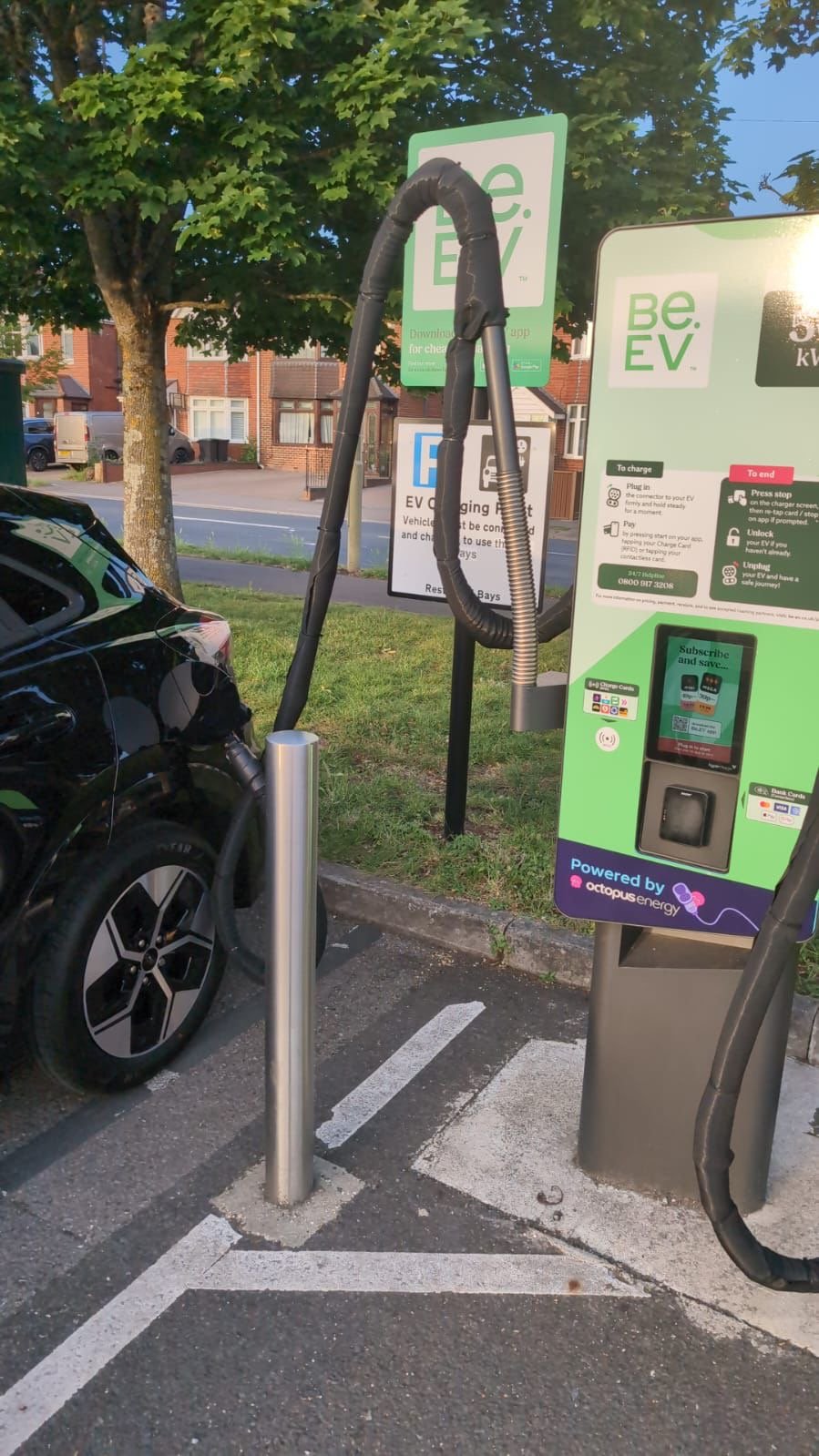
Be.EV Charger
Tesla Superchargers
Tesla has opened a large proportion of its network to non-Tesla owners and - just like Be.EV - membership subscription drops the rates considerably, and sometimes below even Be.EV’s lowest rates. Tesla Superchargers are also one of the most reliable operators out there, too.
For non-Tesla drivers, you will need to use the Tesla app to access these prices, but for Tesla drivers it’s simply a case of turning up at the Supercharger and plugging the car in and walking away. No apps or cards necessary as the cost is billed to the card stored in their Tesla account.
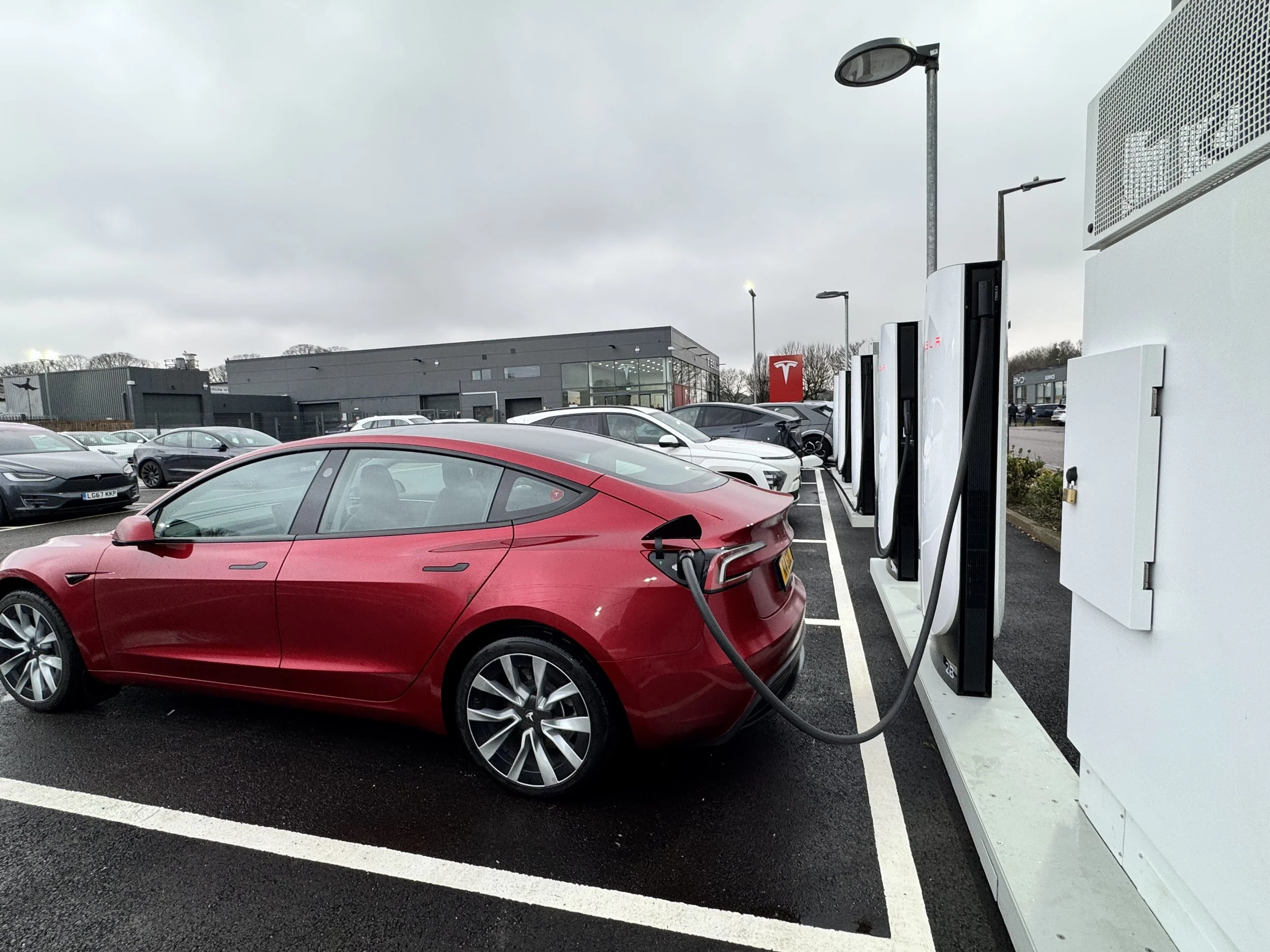
Tesla Superchargers, St. Albans
What Else
Zapmap and Octopus’ brilliant Electroverse bring a lot of the network operators under one account, or one RFID card, and are aligned to Apple CarPlay and Android Auto for routing, too.
However, Octopus Energy goes a step further with their Electroverse account ensuring a small discount is available (up to 8%) from several of their affiliated operators.
This benefits those who choose not to have a glovebox of RFID cards (one for each operator), or a phone filled by charging apps.
Electroverse also has regular Plunge Pricing events where an abundance of surplus green energy from renewables is available. Octopus pass the savings on to Electroverse customers with 20% discounts, and sometimes as much as 40% off. Occasionally it’s even free!
Cost Comparison: EV vs ICE
So, when does an EV match the running cost of that 500 mile range diesel?
Zapmap’s website has a handy calculator which is brilliant for calculation just this. Simply add in your model and they show public charging hitting cost parity with petrol/diesel around the 50–60p/kWh mark for efficient EVs.
Note: real-world efficiency should be considered for further savings with ~3–4 mi/kWh a good benchmark, but lots of modern eVs can do much better than this now.
With an efficient eV, and with charging deals from Be.EV or Tesla membership, you’re ahead even on public charging power alone. Average standard public rates (~54p/kWh) work out to ~16p per mile — already competitive with or better than many petrol (16–17p+) and diesel cars.
Per-mile examples (approx. 3.5 mi/kWh):
Home/off-peak: ~2–5p per mile (depending on car and efficiency).
Be.EV Mega or good public deals: ~11–15p per mile.
Petrol (efficient car): Often 15–20p+ per mile.
Diesel: Typically 14–18p per mile.
For those covering 12,000–15,000 miles a year the differences add up fast, and even more so versus diesel. And the more mileage covered, more money is saved when driving an eV and choosing the least expensive chargers.
Total Cost of Ownership: EVs vs Petrol & Diesel
Fuel is only part of it. Over the years EVs come out well ahead when you do the maths and consider total cost of ownership:
Energy/Fuel: Home charging slashes hundreds to £1,000+ off annual costs. Mixing home charging and public charging - with smart subscriptions - beats ICE easily especially for high mileage drivers.
Servicing & Maintenance: Fewer moving parts means no oil changes, exhausts, clutches or traditional gearboxes. Regenerative braking cuts brake wear to almost nothing.
This significantly reduces service costs. And with less maintenance, and fewer and less extensive services needed, over five years the savings are around £4,000 for EVs vs ~£5,700 for petrol/diesel equivalents.Reliability: Simpler drivetrains mean fewer breakdowns or issues. This is something I see in effect personally as a used car dealer. The eVs cause us little to no stress whatsoever, which is something that I can’t say about the fossil stuff, and it’s not even close
Studies show over 80% of new BEVs save money vs petrol equivalents (average ~£5,850), with used EVs strong too. Diesel is similar but the fuel gap is narrower and EVs still win overall for most.
Real-world data backs it: mixed users save £500–£1,000+ yearly on energy, with servicing, tax and reliability piling on more.
The UK rapid charging network is now extensive: As of May 2026 there are 28,374 rapid/ultra-rapid chargers at 6,953 locations (Zapmap stats) comparing favourably to around 8,000–8,500 petrol stations nationwide. Be.EV’s growth and open Tesla sites add plenty of good, affordable options.
Charging Times
The old adage that “my diesel car takes 5 minutes to fill up and goes for 700 miles” is a mindset issue, and not necessarily an advantage, especially for those that have the convenience - and low cost - of home charging.
But, on very long journeys, diesels are (I’d argue slightly) quicker to refuel if you just blinkerdly look at the like-for-like ‘refuelling’ times alone as diesel’s typically fill-up in 5–10 minutes.
Modern fast-charging and EVs seriously narrow the gap. For example, a Kia EV6 AWD (like mine) can do 10-80% in around 18 minutes on an ultra-rapid. A Tesla Model 3 Long Range manages similar or quick sessions (15–25 minutes on V3/V4 Superchargers) adding 150–200+ miles of range in that time.
However, BYD is launching its FLASH charging standard in the U.K. right now, with a full charge in one of its FLASH compatible cars taking as little as 9 minutes. That’s progress!
But here’s the clincher, because many drivers use a stop productively for a comfort break, coffee, meal or quick stretch whilst their car is charging - and with better network density plus a little planning - it feels far less disruptive than it used to.
Practical Tips
Smart habits usually soften the costs.
Prioritise home or work charging whenever possible.
Grab subscriptions like Be.EV Mega, Tesla or Ionity membership for public use.
Use app to plan and compare or just filter for your preferred cheap charger operators.
Conclusion
With cheap home energy tariffs, plus targeted public deals like 39p/kWh, EVs give lower total ownership costs than petrol or diesel for most UK drivers, new or used. Add in less servicing, less headaches because of better reliability, strong real-world range retention and that fun, powerful EV driving experience, and the case is strong.
The data and tools like Zapmap’s calculators make it clear; let alone hearing first hand from from experienced real world users like ourselves here at CtrlAltRefuel. As we have been driving eVs a long time now, if diesel was better or cheaper, we’d still be driving one.
Petrol, diesel or electric? Drop your thoughts in the comments or on socials- we love the real driver stories. Stay ahead, drive an EV!
Author
Newt is a lifelong car enthusiast and specialist in electric cars.
You can find Newt on 𝕏 at @eV_Newt
