
EV Fires: The Stats, the Panic, and the Reality.
Every time a car or bus goes up in flames on a dual carriageway, or in a carpark, a familiar cry goes up on social media: “It’s an EV!” Most often, of course, it isn’t. And the likelihood of it being an EV, is very slim.
Then the next shout out is: “well it’ll be a hYbRiD then!”, but here, they have more chance of being right and we’ll explain why.
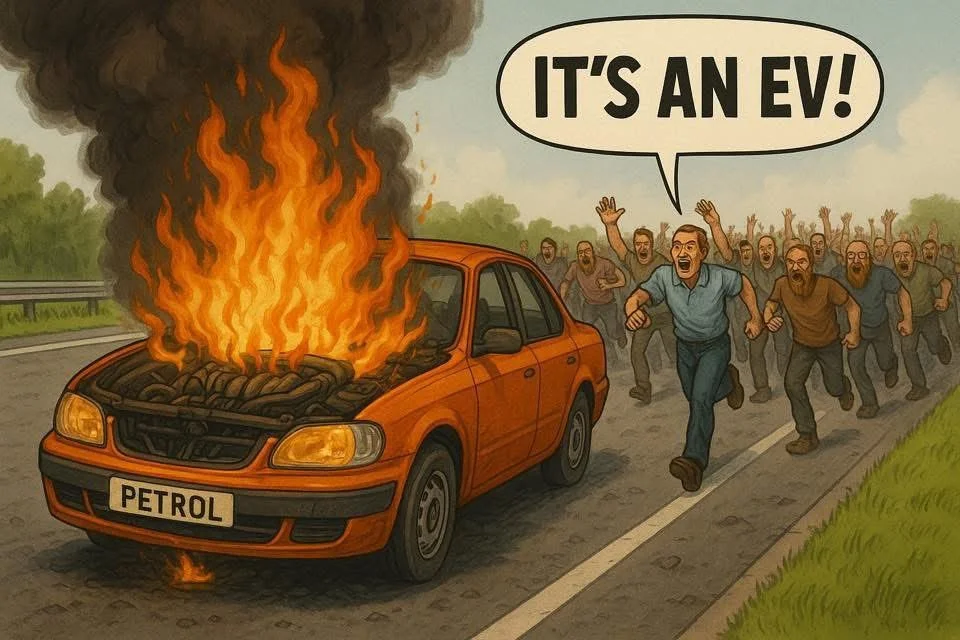
Meme generated by Newt (not a real image)
The orange car in the classic meme has “PETROL” written on the number plate, yet the crowd is still screaming that it must be electric. That single image sums up the problem better than most articles. Perception has run a long way ahead of the data.
More classic goalpost moving, usually shifts the ‘angries’ on further:
“There are millions more ICE cars, so of course they have more fires!” This is the most common push-back and it sounds reasonable until you look at and take a second to understand the stats.
Absolute numbers will always favour the much larger fleet of course and yes, there are far more petrol and diesel (which includes hybrid) cars on the road than EVs, so in raw counts they produce more fires. But that does not tell you which type of vehicle is more likely to catch fire though, so the useful comparison is fires PER VEHICLE or per mile driven. On those measures the picture is consistent.
EVs catch fire much less often
Actual stats support this headline as the Swedish national data puts petrol and diesel cars at around 77 fires per 100,000 registered vehicles, and battery-electric vehicles at roughly 3.8 per 100k. That is about twenty times lower for the EVs. Tesla’s long-term figures show one fire event per approximately 135 million miles, against a broader US average nearer one fire per 17–18 million miles.
Rates exist precisely so we can compare risk fairly across different sized groups. Ignoring the ‘per X’ sample size, is like saying more people die in hospitals than climbing mountains, so hospitals must be more dangerous.
In rare EV fires, the battery often does not even catch fire. This is another detail that gets lost: when an electric vehicle is involved in a fire, the high-voltage battery pack is frequently not the source and quite often, does not ignite at all.
Fires can start in the cabin, from tyres/brakes, from an adjacent vehicle, or from external causes, and in many documented cases the battery remains intact. Modern pack design, battery management systems, and cell chemistry have improved significantly.
BYD’s Blade battery (using LFP cathode chemistry) is a well-known example. In the public nail-penetration test, a steel nail is driven through the cell to simulate a severe internal short or accident. The Blade battery produced no fire and no smoke and the surface temperature stayed in the 30–60°C range. Impressive stuff.
However, the more energy dense NMC cells (Nickel Manganese Cobalt cathode chemistry) can burst into flames in such a nail-puncture test, yet these cells are still less likely (by many more times) to catch fire vs petrol, diesel or hybrid cars.
That does not mean every EV battery is immune, or that eVs don’t and can’t catch fire (anything can catch fire of course) but it shows how far some chemistries have come in resisting thermal runaway. However, despite the slim chance that an EV battery could ignite, there are multiple risk mitigation technologies within the pack that can quell a fire, such as using fire retardant pack fillers, penetration resistant pack materials and a thermal management system that can react and isolate part of a pack or the individual cell. Much work has gone into mitigating fire risk.
Plastic fuel tanks, burning liquid, and the Luton Airport fire
ICE fires have their own hazards that receive far less attention. Most modern petrol and diesel cars use plastic fuel tanks and in a serious fire the tank can melt or rupture. Ignited liquid fuel then runs out under the vehicle and across the ground, spreading the fire rapidly to neighbouring cars or structures. That runoff effect is one reason multi-vehicle fires in car parks can escalate so quickly.
The 2023 Luton Airport multi-storey car park fire is the clearest recent UK example. The blaze started in a diesel Land Rover (which had just entered the car park). The car ignited and the fire spread quickly through the structure, destroying more than 1,400 vehicles and causing the partial collapse of the car park. Burning fuel and the way fire moved between vehicles turned a single car fire into a major incident. Plastic tanks and liquid fuel behaviour played a part in how fast it grew.
“But diesel doesn’t burn”
This line appears regularly, but it is only partially true. Diesel has a higher flash point than petrol, so a match dropped into a puddle of cold diesel often goes out. That is a party trick, not a safety feature in a vehicle fire. Once diesel is heated, atomised, or exposed to hot surfaces (like hot exhaust manifolds) and /or exposed to a sustained flame (exactly the conditions inside a burning car), it burns fiercely and is difficult to extinguish.
Diesel vehicle fires are common and well documented. Claiming “diesel doesn’t burn” is a misconception, but it is a comforting myth that does not match with real-world incidents or reality.
Why the panic continues
EV fires look different. Thermal runaway can make them harder and longer to fight, and reignition is a genuine risk. Even the term ‘thermal runaway’ sounds really bad doesn’t it?
It means that fire services have had to change tactics, and those dramatic scenes travel fast online. Novelty bias does the rest: a burning petrol car is ordinary, a burning EV is still news, and, more importantly, its receives that all-important click! And what do clicks make? Yes. Prizes.
None of this means EV fires are trivial, because they are not. Any vehicle fire is horrendous and manufacturers, fire services and regulators treat them seriously.
Battery design continues to improve. As does the emergency services response with how they tackle them. But frequency and difficulty of extinguishing are separate issues. On frequency, the data remains clear: Petrol and diesel cars (including petrol/diesel hybrids) catch fire more often than eVs.
When you compare like with like, the gap is very wide, cavernous even. Absolute numbers are higher for ICE vehicles simply because there are many more of them, yes, but the probability per vehicle is what matters for risk. And anything that has a fossil engine/liquid fuel source using combustion technology, is orders of magnitude more likely to catch fire. That’s just the cold, hard facts.
Conclusion
When an EV is involved in a fire, the battery is often not the source. Some modern chemistries, such LFP show strong resistance even under severe abuse tests. Meanwhile, liquid fuel runoff from plastic tanks remains a real and under-discussed hazard in ICE fires, as the Luton Airport incident demonstrated.
Drivers are simply much safer in an EV than in a fossil car no matter how much someone doesn’t want that to be true.
So, the next time a car is on fire and someone immediately declares it must be an EV, the safest response is still the simplest one: check the facts first. Most of the time, it isn’t.
