
Porsche’s Electric Boxster and Cayman Are Happening After All. Maybe.
Porsche’s new boss has finally said the quiet part out loud: The electric 718 Boxster (and Cayman) are going ahead. For full disclosure, Porsche and the VW parent group have been flip-flopping on this for a couple of years now, like a pigeon trying to decide which way to walk to the food either side of it.
Michael Leiters told the German press that after “looking at the numbers” they decided to build it. Again. “It is the best economic solution and will become a fantastic car,” he said, and with that, it ends months of indecisiveness for the whole project that was in limbo from getting - and then not getting - the chop, because of alleged costs, delays and in Porsche’s words “softer EV demand”.
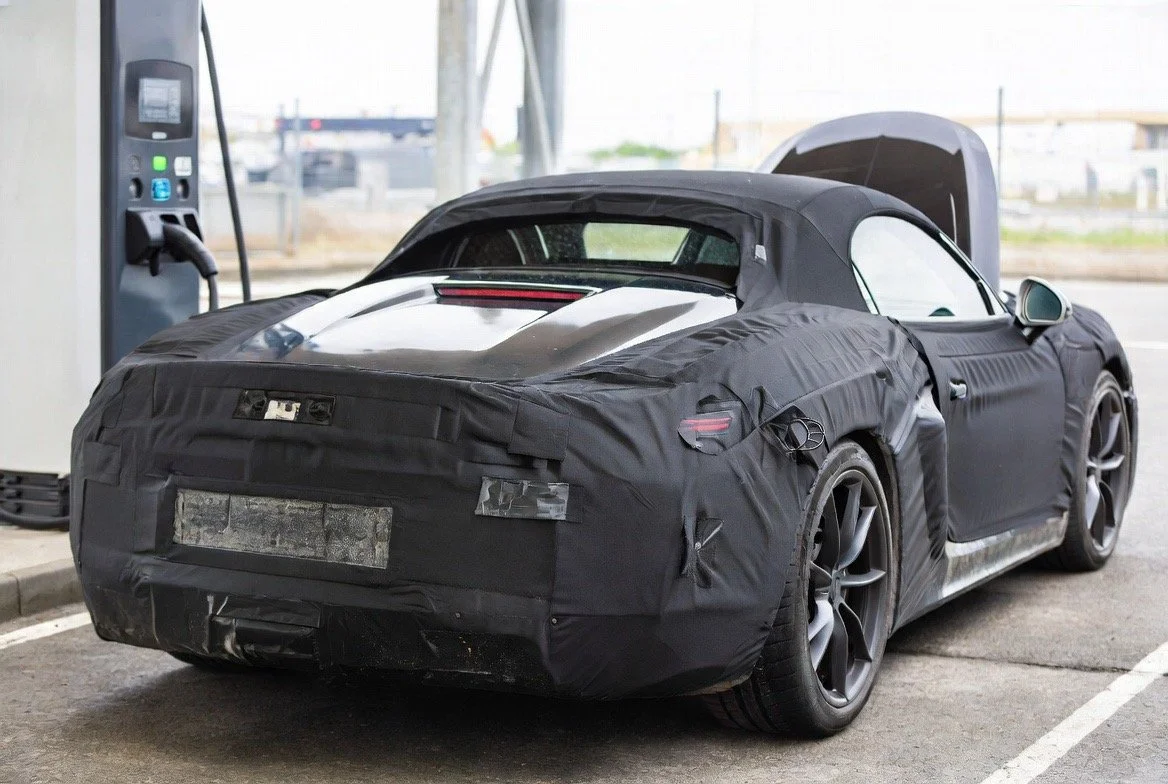
The current combustion Boxster/Cayman 718s finished production late last year, and the electric versions were originally meant to be here by now - and there’s even been prototypes spotted at the Nurburgring and out in the real world charging (under heavy camouflage).
Rendered image
Because of the dithering, we’re looking at 2027 for the launch of the electric Boxster and Cayman, and that’s if the VW “pigeon” doesn’t do yet another about turn.
There will still be some higher-end combustion or hybrid versions for the people who refuse to go fully electric, but the main 718 line is now apparently definitely, maybe, heading to battery-power.
What this actually means
The 718 has always been the more accessible Porsche, not that it’s cheap, but the one that didn’t require you to re-mortgage the house or suddenly ‘become divorced’. An electric version that keeps the size and the balance could be a great alternative to the heavier, more expensive electric sports cars already on the market.
Porsche already knows how to make an EV that feels special. The Taycan proved that. With instant torque, low centre of gravity from the battery pack, and the chance to use their clever and expertly tuned torque vectoring. On paper the electric 718 should be sharp, and be no slouch, and perhaps sharper than the previous generation.
Running costs will be better for most people too. No more watching the fuel gauge drop like a stone when you’re having fun, and such ‘occasional-use toys’ lend themselves perfectly to an EV platform and it’s convenience.
But is something important being lost?
Well even I think maybe so, and this is the part that winds people up, because a good combustion Boxster or Cayman ‘talks’ to you. The flat-six doesn’t just make power. It makes noise, vibration and drama. The way the engine note changes as the revs climb, the induction sound, the way the whole car -to many- feels allegedly ‘alive’, that some say is the essence of the car.
I’m not sure that this true, personally, and I’m not a believer in the ‘bUt ThE SoUl’ argument. I’ve had a few Boxsters and a couple of 911’s in the past, so I talk from experience. However, we must recognise that this is a big part of why people buy these cars.
An EV mostly just goes very quickly and it does that pretty quietly. Porsche will almost certainly add a synthetic soundtrack, like they do in the Taycan. It can be good, but it is still an approximation. You can turn it up or down, but you cannot, for many, fully replace an old-fashioned engine spinning past 7,000 rpm or whatever.
Weight is another issue. Even with careful packaging, batteries add mass, in unfamiliar places, but Porsche are good at managing it. However, physics is still physics and extra mass can blunt that pure, lightweight, go-kart feeling that made the best 718s special.
However if anyone can get this right and ‘add soul’ and sharp handling, Porsche can, and I sincerely hope they do.
It will need the augmented noise and the Hyundai Ionic 5N style simulated gearshifts for me, as these cars are meant to be used in relative spirited fashion, and on interesting roads-rather than just motorways.
Charging interruption I feel is a not an issue. These cars always had small relative ranges and you’re not really going to be doing long distances, with time restrained trips in such a thing. However, Porsche’s 800-volt system should help minimise time spent at the rapid chargers, if you do want to.
So is it a good idea?
Commercially and practically, yes. Regulations are heading one way, plus younger buyers care less about engine noise, and Porsche has shown they can make electric cars that feel special. The electric 718 will almost certainly be fast, efficient and very capable on the limit.
Emotionally, for perhaps the older, traditional enthusiasts, something may be lost. The soundtrack, the mechanical connection, the eye-watering repair and servicing cost, that slightly unruly character you only get from a high-revving engine, all add to ‘the experience’.
Whether that loss is a deal-breaker depends on what you actually want from a sports car in 2027 /2028, and of course, how well Porsche do their job.
We don’t want huge range and we don’t want a bloated, over-complicated ‘everyman’ sports car. We want lightness, fun and feel. Porsche’s own answer seems to be “have both for a while.” Top ICE versions will apparently still exist, and that might be the most sensible middle ground – give the purists their aging flat-six new ‘classic car’, while the rest of the range goes electric and does what electric does best. Hopefully this approach blows the old days away in the process
The real test will come when we drive it. If Porsche has kept the balance, the steering feel and the sense of occasion, then the lack of engine noise might not matter as much as some of us fear. If it just feels like a very fast, very quiet appliance, the critics will have a point. And VAG will have failed in their brief.
So personally, I’d rather they didn’t bother if they’re not going to make a good go of it, but we’ll find out soon enough. Until then, the electric Boxster and Cayman are officially happening. No more maybes. Or maybe some more maybes.
What do you think? Will an electric Cayman still feel like a Cayman? Or is the magic going to get lost in the battery pack? Drop your thoughts to us on the socials.
Note: All images were rendered using AI
