
The Quiet Death of the Diesel Car (continues, unabated)
A few years back diesel was still the default choice-especially for company car drivers. High mileage, solid residual values, and the belief that nothing else could do the job. That world is rapidly vanishing, and has been for a good while
HMRC figures for 2024/25 show diesel now makes up just 7% of company car registrations. That’s down from around 80% a decade earlier. New diesel registrations overall are hovering between 3.8% and 4.6% of the market in recent months according to SMMT data. In comparison, battery electric vehicles are sitting at 25% to 30% indicating the shift is far from a subtle one.
Tax did most of the heavy lifting however
In the 2026/27 tax year a pure electric company car sits at 4% Benefit-in-Kind. Most diesels are in the mid-20s to 37% band depending on CO2. A higher-rate taxpayer on a £40,000 list-price diesel can easily be paying four or five times more annual tax than the same person in an equivalent EV. The employer also pays Class 1A National Insurance on that higher taxable benefit, then add fuel price swings and higher servicing costs and the arithmetic becomes brutal.
As always-fleets noticed first and the company accountants know when something with a cheaper total cost needs switching to.
Leasing data shows electric vehicles now accounting for well over 80% of some company car order books and ‘Dirty Diesel’ is the shrinking minority.
What this means for private and used-market buyers
The company car supply channel used to set the tone for the whole used market. Three-year-old ex-fleet diesels were plentiful, desirable, and held their money well. That pipeline is not only drying up, but the appetite for them has long subsided, while the last big waves of 2021–2024 diesel company cars are still landing on auction sites.
For private buyers this creates a short-term anomaly. Clean, low-mileage diesels are still available and often cheaper relatively than they would have been a few years ago because demand from the next company-car cycle has vanished.
If you genuinely need that “I’m not stopping for 600 miles!” range, the towing ability, or simply prefer diesel, there are bargains to be had right now. The catch is that the pool of nearly-new examples is shrinking fast, and older diesels face the usual ULEZ and Clean Air Zone pressures in cities, let alone the reliability grief and servicing costs.
On the EV side the picture is different. Used (now really capable) electric cars are arriving in growing numbers on the 2nd hand market. Many are turning over quicker than equivalent diesels on the big platforms. Savvy buyers looking for lower running costs are snapping them up, especially in the 3 to 5 year-old bracket.
Residuals for EVs have been under pressure from the volume of stock and new-car discounting, but the gap with petrol and diesel has narrowed and, in cash terms, a three-year-old EV often sits close to the market average residual value. And close or even below that of an equivalent ICe.
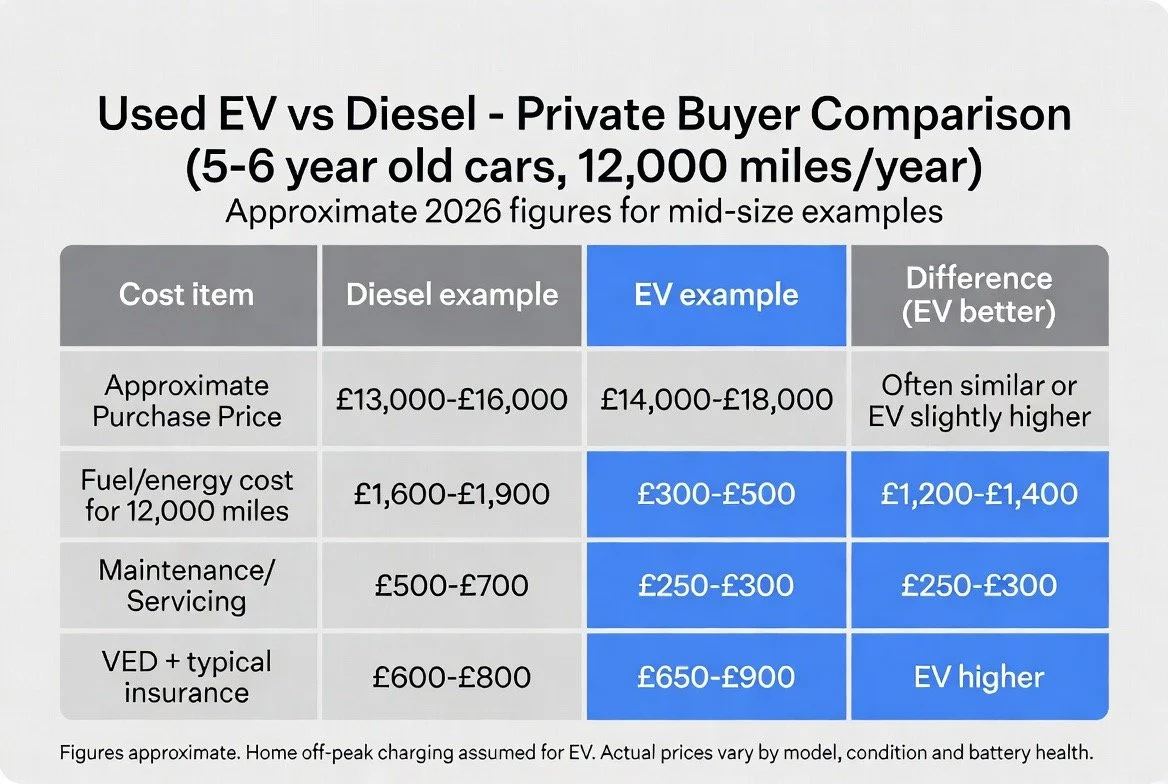
Private buyers who once ignored company-car leftovers now have a clearer choice. Pay a bit more for a recent diesel and accept higher fuel and tax costs, or take a used EV with lower day-to-day running costs, more convenience and less faff.
Total cost of ownership: the real numbers
Here is a straightforward comparison for a typical higher-rate taxpayer (40%) covering 15,000 miles a year. Figures are approximate based on current 2026 rates and typical mid-size cars around the £38–40k list-price mark.
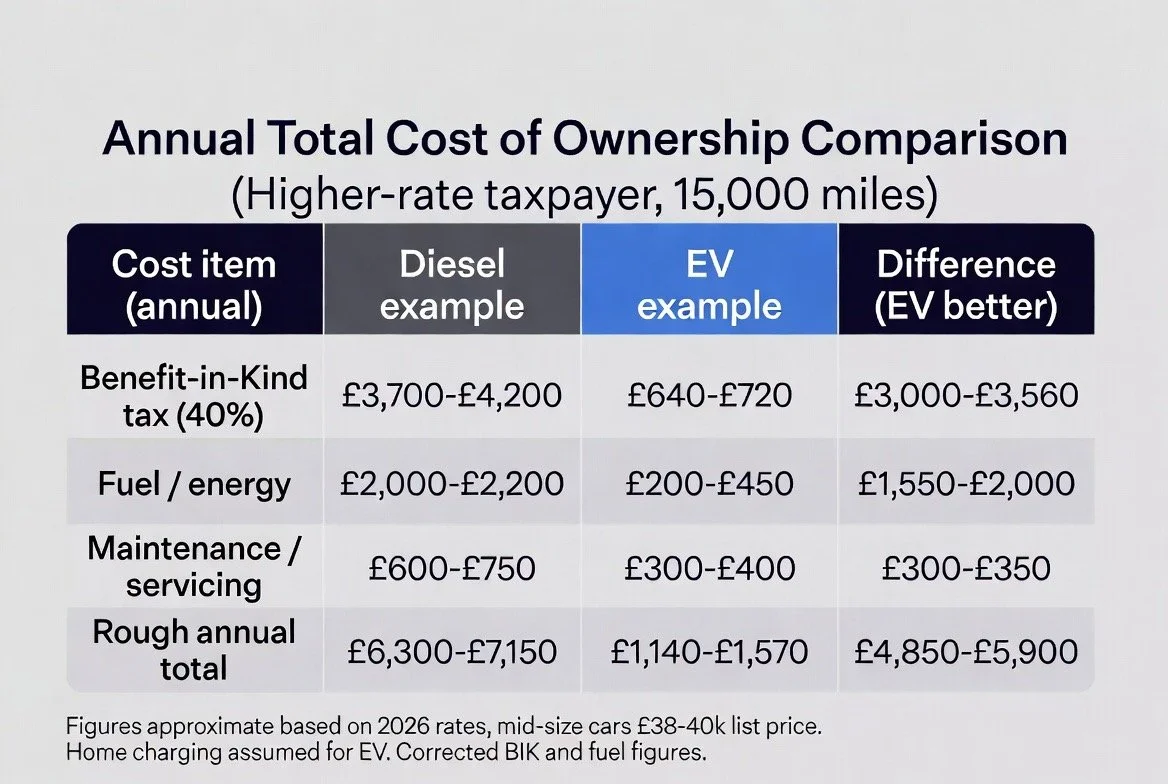
Assumptions
• Diesel: 50 mpg, diesel at £1.50/litre
• EV: 3.5 miles/kWh, 80% home charging on an off-peak EV tariff at 8p/kWh, 20% public at average rapid rates
• Maintenance: diesel higher due to oil, filters, exhaust; EV lower
• BIK based on 2026/27 rates
• Three-year ownership window
Over three years the driver of the diesel is looking at roughly £13,500–£17,000 more in tax and running costs alone, before any residual value differences. For the private buyer purchasing outright or on PCP the picture is similar once you strip out the BIK element: the EV still wins on energy and maintenance, though the purchase price premium and residual value need careful checking on the specific models.
Home charging is the key variable. Anyone forced onto public rapid chargers all the time sees the energy advantage shrink (but savings are still doable) Anyone on a proper off-peak tariff or with solar sees it widen further.
So, who is still choosing diesel?
A few groups remain. Drivers who genuinely cannot charge at home or work, or don’t want to explore public charging, commercial vehicles that need the range or payload, and those who simply have not run the current numbers. Even among those groups the conversation is changing.
Longer-range EVs and the remaining tax-efficient PHEVs are taking more of the decisions. From April 2028 the PHEV tax treatment flattens to 18% regardless of electric range, which removes another temporary bolthole.
The bottom line
Diesel company cars are not being banned. They are simply becoming an expensive and increasingly irrational choice for most drivers and most fleets. The tax system, the residual values, and the running costs all point the same way.
What we are watching is a quiet, market-driven cull. The cars will keep appearing on the used market for a few more years, but the pipeline that fed them has already dried up. Private buyers can still find good examples if they want them, but the long-term direction is clear. Drivers still clinging to diesel for “range” or “resale” are often comparing yesterday’s assumptions with today’s reality.
The numbers are not subtle. The market has already voted with its orders.
From my used car dealer perspective, I avoid diesels as much as possible at the cheaper end of the market (3-20k), and I have done for a few years now. I will only consider them (reluctantly) in part exchange, purely because they are a tough sell and the reliability/warranty issues are often great.
Sources: HMRC company car benefit statistics (diesel share of company cars in 2024/25); SMMT monthly and annual new-car registration data (diesel and battery-electric market shares); official HMRC/GOV.UK Benefit-in-Kind tables for the 2026/27 tax year (including the 4% rate for pure electric cars); BVRLA Leasing Outlook reports and individual leasing company order data (EV share of company-car orders); DESNZ/Department for Transport vehicle licensing and fuel-consumption statistics where referenced for context; and illustrative calculations for the total-cost-of-ownership charts based on those BIK rates, typical mid-size list prices (£38–40k), stated fuel/energy assumptions (diesel ~50 mpg at ~£1.50/litre; EV ~3.5 miles/kWh with predominantly home off-peak charging), and standard industry averages for maintenance differentials. Used-market purchase-price ranges and residual observations draw on general 2026 market data and the author’s own used-dealer experience. All chart figures are approximate.
